
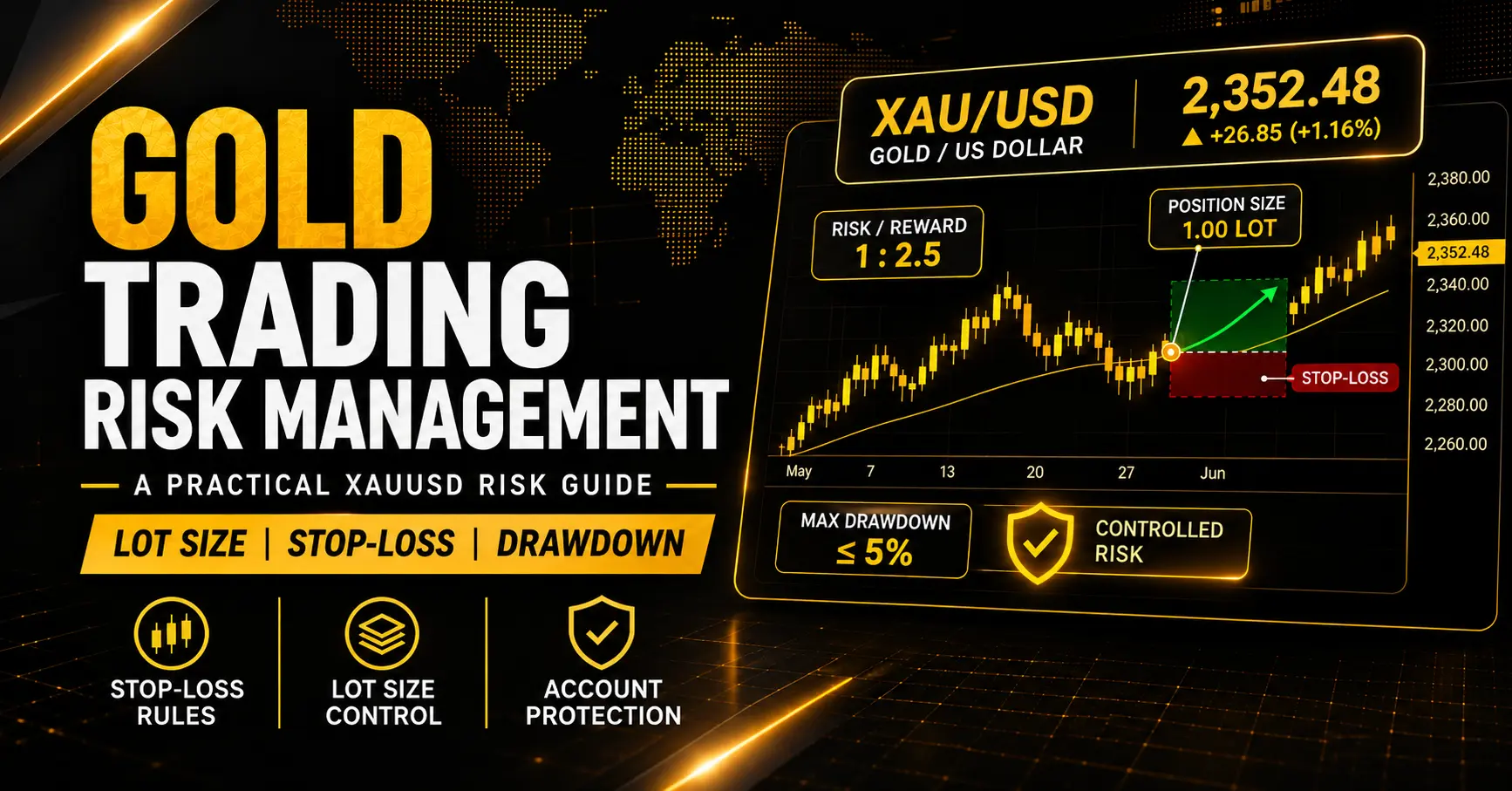
Gold can move quickly. A trade may look good at first, but one sudden price change can lead to a large loss.
This is why gold trading risk management matters.
Many traders focus on finding the right entry price. They study charts and wait for buy or sell opportunities. But they often forget to check how much money they could lose.
A good trading plan starts with risk, not profit.
For example, two traders may follow the same gold trading signal. One uses a small lot size and a stop-loss. The other opens a large trade without checking the risk.
Even with the same entry price, their results can be very different.
This guide explains how to manage risk in XAUUSD trading. It also covers ten common mistakes and simple ways to avoid them.
What Is Gold Trading Risk Management?
Gold trading risk management means planning how much money you are willing to lose before opening a trade.
It includes choosing a suitable lot size, setting a stop-loss, and knowing when to stay out of the market.
The goal is not to avoid every loss. No trader can do that.
The goal is to stop one bad trade from causing too much damage to your account.
For example, a trader with $1,000 may decide to risk only $10 on one trade. If the trade fails, the planned loss is 1% of the account.
This is one way to control trading risk.
Why Is Risk Management Important in Gold Trading?
Gold is also called XAUUSD when traded against the US dollar.
Its price can react quickly to economic news, interest-rate changes, and world events.
During busy trading sessions, gold may move sharply in either direction.
This creates opportunities, but it also increases the chance of losses.
Without a clear risk plan, traders may open large positions or keep losing trades open for too long.
Good risk management helps traders make decisions before emotions take over.
10 Common Gold Trading Risk Management Mistak
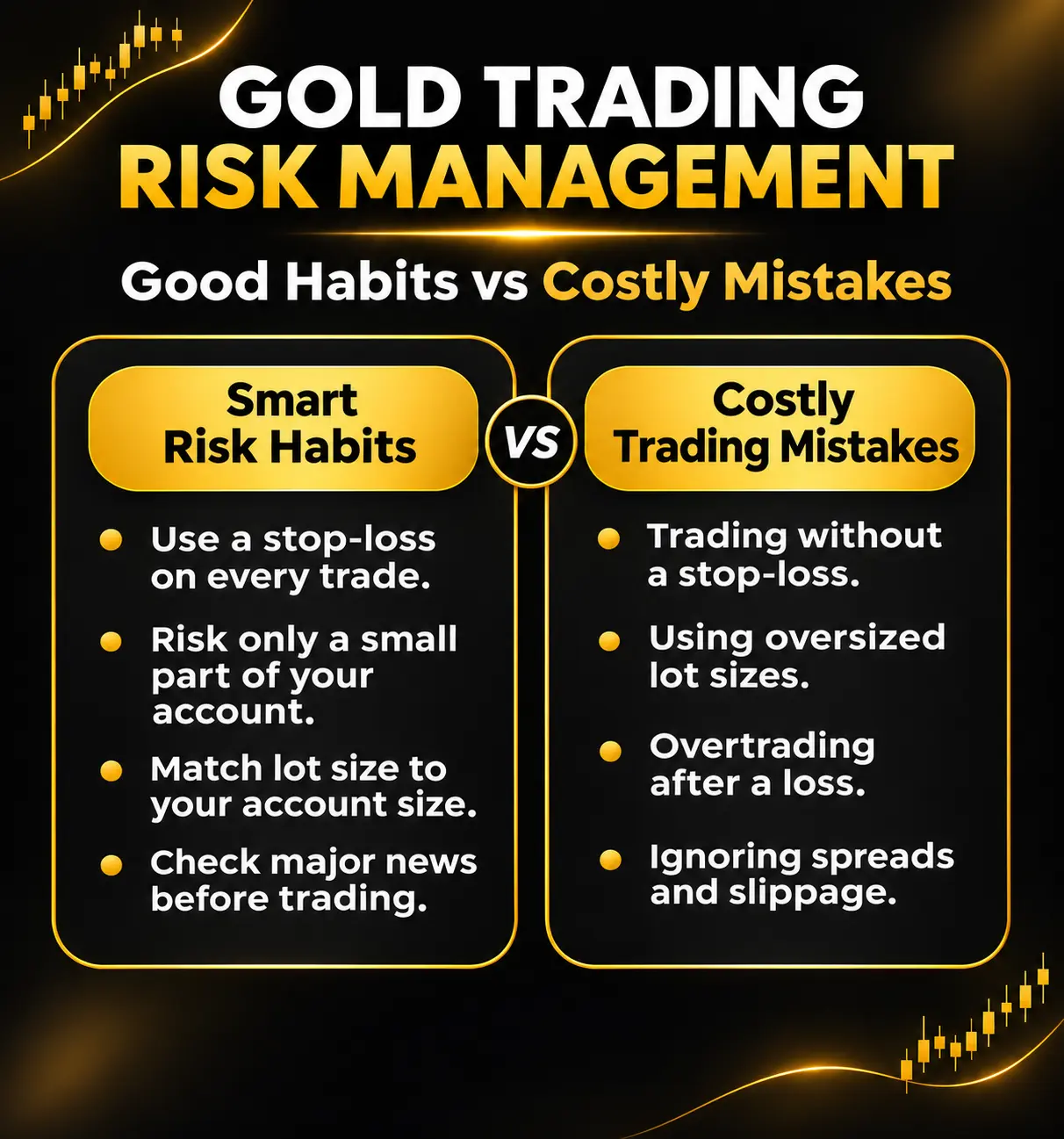
1. Trading Without a Stop-Loss
A stop-loss is an order that can close a trade when the price reaches a chosen level.
Some traders avoid using one because they believe gold will turn back.
But the price may continue moving against them.
For example, you buy gold at $4,000 and set a stop-loss at $3,980. Your planned stop distance is $20 per ounce.
Without a stop-loss, you may end up holding the trade through a much larger price fall.
A stop-loss helps manage risk, but it does not guarantee an exact exit price.
The US Securities and Exchange Commission explains that stop orders may execute at a different price during fast market moves.
2. Using a Large Lot Size
Lot size tells you how large your trading position is.
A bigger lot size means the same price move can produce a bigger gain or loss.
Some traders increase their lot size because they want to make money faster.
However, a small move against a large position can reduce an account quickly.
Always calculate the possible loss before choosing your lot size.
3. Risking Too Much on One Trade
One common approach is to limit planned risk to a small part of the account, such as 1% per trade.
This is a planning example, not a rule that suits everyone.
|
Account Balance |
1% Planned Risk |
|
$500 |
$5 |
|
$1,000 |
$10 |
|
$2,000 |
$20 |
|
$5,000 |
$50 |
These amounts show the planned risk before fees and possible slippage.
If your account is small, the broker’s minimum lot size may be too large for your risk limit. In that case, skipping the trade may be safer.
4. Moving the Stop-Loss After a Loss
Some traders move their stop-loss farther away when a trade starts losing.
They hope gold will turn back.
But this increases the amount they may lose.
A stop-loss should be placed where the original trading idea no longer makes sense.
If you change it, there should be a clear trading reason.
Moving it only to avoid taking a loss is a common mistake.
5. Ignoring Major Economic News
Gold can react strongly to important US economic reports.
These include inflation data, employment numbers, and Federal Reserve decisions.
A trade that looks stable may change direction after major news.
Before trading, check the economic calendar.
Also, be careful when trading near a news release. Spreads may widen, and orders may execute at unexpected prices.
6. Trading Without a Risk-to-Reward Plan
Risk-to-reward compares the amount you may lose with the amount you hope to gain.
Imagine you plan to risk $20 on a gold trade.
Your profit target is $40.
This gives a planned reward-to-risk ratio of 2:1.
But if you risk $50 to make only $10, one losing trade can cancel several small wins.
A good ratio does not guarantee success. It simply helps you compare possible gains and losses before entering.
7. Overtrading After Losing Money
After a loss, some traders feel they must win their money back quickly.
They open more positions without waiting for a clear setup.
This is often called revenge trading.
It can lead to bigger losses because emotions replace the trading plan.
Set a daily loss limit before you start.
If you reach that limit, stop opening new trades for the day.
8. Ignoring Trading Costs
Gold trading includes costs that can change your final result.
These may include the spread, broker commission, overnight fees, and slippage.
A trade may reach your planned target but still earn less than expected.
These costs are especially important for traders who open many short-term positions.
Check your broker’s trading conditions before entering a trade.
9. Using Too Much Leverage
Leverage allows you to control a larger position with less money.
This can make trading easier to access, but it also increases risk.
For example, a small price move against a large leveraged position can cause a serious loss.
Do not choose a position size only because your broker allows it.
Your lot size should match your risk plan, not your maximum buying power.
10. Following Gold Signals Without Checking Them
Gold signals may include an entry price, stop-loss, and take-profit.
But not every signal will suit your trading account.
A signal may arrive late. The price may have already moved far from the entry level.
Before following any alert, check the current price, stop-loss distance, lot size, and market conditions.
If the planned entry is no longer available, avoid chasing the trade.
How to Calculate Lot Size for XAUUSD
Position sizing is an important part of risk management in trading.
Let’s use a simple example.
Suppose you have a $2,000 trading account.
You decide to risk 1%, which equals $20.
You plan to buy gold at $4,000 with a stop-loss at $3,990.
The stop distance is $10 per ounce.
Assume your broker uses 100 ounces for one standard lot.
Your planned risk allows you to trade two ounces of gold. Under this contract size, that equals 0.02 lots.
|
Trade Detail |
Example |
|
Account Balance |
$2,000 |
|
Planned Risk |
$20 |
|
Entry Price |
$4,000 |
|
Stop-Loss |
$3,990 |
|
Stop Distance |
$10 per ounce |
|
Position Size |
0.02 lots |
|
Planned Loss |
$20 before costs |
The calculation is:
Position size in ounces = Money at risk ÷ Stop distance
$20 ÷ $10 = 2 ounces.
The lot size depends on your broker’s contract rules.
The gold pip calculator explains how price changes and position size affect the value of XAUUSD trades.
Gold contracts do not all have the same size. For example, CME Group lists several gold futures contracts with different ounce amounts.
Futures contract sizes should not be confused with your broker’s spot gold or CFD contract settings.
Always check the instrument details before placing a trade.
How to Set a Stop-Loss in Gold Trading
A stop-loss should fit the chart and the trade idea.
For a buy trade, a trader may place a stop below an important support level.
For a sell trade, the stop may sit above resistance.
However, the distance should also match the account’s risk limit.
If the stop is too far away, reduce the position size or avoid the trade.
If the stop is too close, normal price changes may trigger it before the expected move happens.
Support and resistance levels are common tools in gold technical analysis, but they cannot predict every market move.
Risk Management for Copy Trading Followers
Copy trading allows a trader to follow trades made by another account.
This can save time, but the follower still faces trading risk.
A copied trade may use a position size that is too large for the follower’s account.
There may also be a delay between the original trade and the copied order.
Before using copy trading, check the trader’s past losses, drawdown, leverage, and position sizes.
Risk management for copy trading followers means setting personal loss limits rather than copying every trade without review.
Can Trading Risk Management Software Help?
Some traders use trading risk management software to track account exposure, lot sizes, and losses.
A basic position-size calculator can help estimate risk before a trade.
A trading journal can also help traders review their mistakes.
Larger firms may use commodity trading and risk management software to monitor positions across several markets.
These business systems are different from the tools used by most individual XAUUSD traders.
Software can help with calculations and monitoring. However, it cannot guarantee that a trading strategy will make money.
A Simple Gold Trading Risk Checklist
Before opening a gold trade, ask yourself:
- Is the market trend clear?
- Where is my entry price?
- Where should the stop-loss go?
- How much money could I lose?
- Does my lot size match that risk?
- Is important economic news coming?
- Am I following my plan or reacting to emotions?
If you cannot answer these questions, you may need more time before entering the trade.
Conclusion
Gold trading risk management is about controlling possible losses and making careful trading decisions.
A good entry price is useful, but it is only one part of a trade.
Lot size, stop-loss placement, leverage, trading costs, and emotions all affect your results.
Knowing when the market is active also matters. The guide to gold trading hours explains how global sessions affect trading activity.
No trading method can remove every risk. The aim is to make decisions based on a clear plan rather than hope.
Frequently Asked Questions...
What is risk management in gold trading?
It means planning how much money you can lose before entering an XAUUSD trade. It includes lot size, stop-loss placement, and loss limits.
How much should I risk per gold trade?
Some traders use 1% of their account as a planning limit. However, the right amount depends on your finances, experience, and risk tolerance. Actual losses may exceed the planned amount.
Why is a stop-loss important in XAUUSD trading?
A stop-loss helps control possible losses when gold moves against a trade. However, the final exit price may differ from the stop level.
Can trading risk management software prevent losses?
No. Software can help calculate position sizes, track results, and monitor account exposure. It cannot prevent market losses.
What is the biggest mistake in gold trading?
One major mistake is opening a trade without knowing the possible loss. Large positions, excessive leverage, and poor stop-loss planning can make this problem worse.