GGold has always been one of the most closely watched assets in financial markets. During stretches of economic uncertainty, worries about inflation, or sudden geopolitical events, traders often drift back to gold as a barometer for what’s going on. But honestly, making smart calls in the gold market takes more than just staring at price ticks.
Traders still need some sort of structured approach, even a rough one, so they can read the environment and maybe spot opportunities before they get obvious. And that’s where the idea of the four golden signals comes in. It’s not like any single signal can promise results, but using multiple cues together can push your decisions closer to the truth, especially when you’re looking at gold signals, gold and forex markets, and related assets.
In this guide, we’re going to walk through the 4 golden signals that a lot of traders keep an eye on and talk about how they can be used to improve how you analyze the market.
Why Understanding Gold Market Signals Matters
Gold prices don’t move in a vacuum. Rates, inflation, economic releases, central bank decisions, and even investor sentiment all weigh in at the same time. Since several variables interact together, using only one indicator can leave out the rest of the story, and you end up with a partial view.
That’s why many traders rely on a combination of indicators and broader market analysis techniques. The idea is to map trends, gauge momentum, and get a better grasp of what’s really driving those price swings.
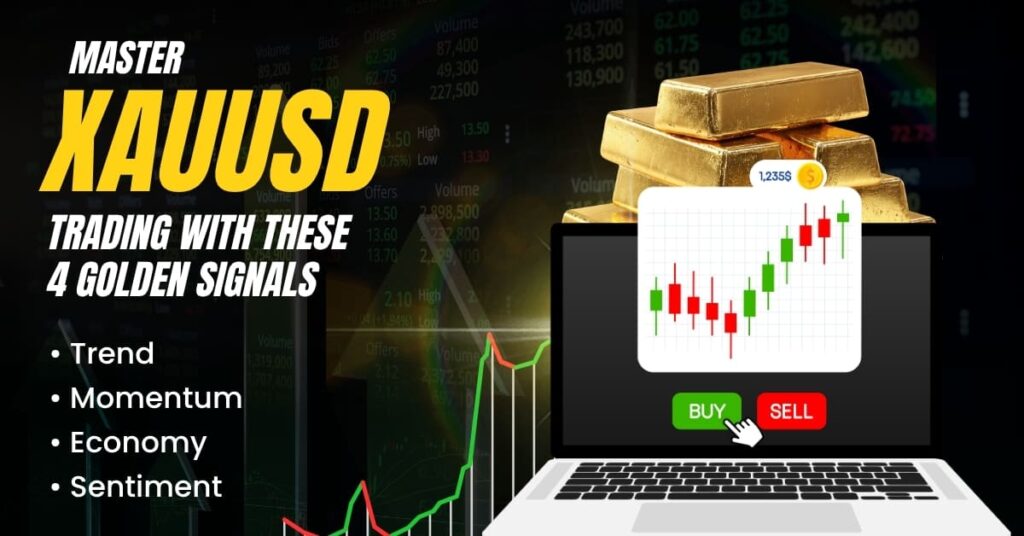
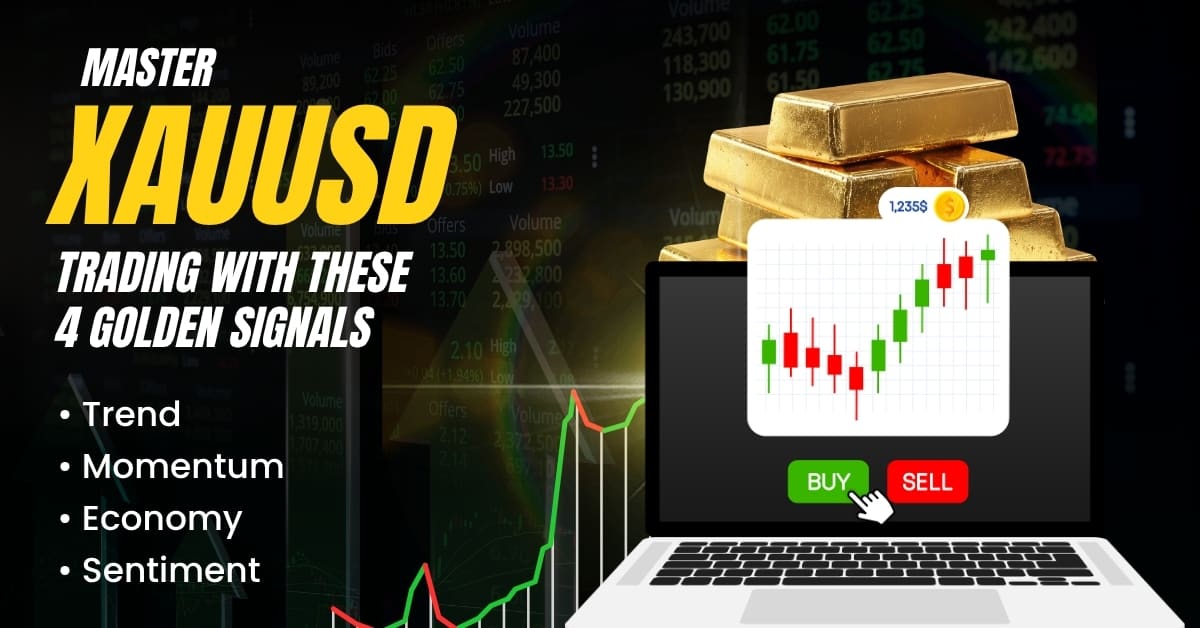
So the first step is to understand the four golden signals that can help form a stronger analytical base, even if you start simple. Many traders who follow golden signals, trading signals, and xauusd trading signals use these principles as part of their market analysis process.
Signal 1: Trend Direction
One of the more important factors in market analysis is, uh, figuring out the overall trend.
A trend basically describes the general direction in which the market is drifting. Traders usually sort them into three buckets, like Uptrend, Downtrend, and a Sideways market.
When gold prices keep printing higher highs and higher lows, too, the market might be in an uptrend. On the flip side, lower highs followed by lower lows can be a hint of a downtrend, even if it feels a bit subtle at first.
A lot of market participants rely on moving averages because they’re helpful for spotting trend behavior. For instance, if a shorter-term moving average stays above a longer-term moving average, it can point toward bullish conditions, and you could say that the bias is leaning upward.
This approach is pretty often part of professional gold signals and xauusd trading signals, because grasping the trend helps traders align their decisions with what the market is already doing.
Signal 2: Momentum Strength
After you’ve identified the trend, traders typically look at momentum too, more or less right away.
Momentum shows how energetically prices move in a certain direction. If the trend is strong and momentum is climbing, that may mean more market interest is showing up, while fading momentum can signal that the push is starting to weaken.
Common momentum indicators are:
- Relative Strength Index (RSI)
- Moving Average Convergence Divergence (MACD)
- Stochastic Oscillator
These indicators let traders get a clearer read on whether buyers or sellers are in control.
Many seasoned traders also watch momentum before they actually act on a gold signal or other trading signal, because strong momentum sometimes acts like a confirmation, like “yes, this move is for real”.
Signal 3: Economic and Fundamental Drivers
Gold is pretty responsive to economic changes, so fundamentals matter a lot.
Key drivers that tend to influence gold prices include:
- Inflation reports
- Interest rate decisions
- Employment data
- Central bank policies
- Global economic uncertainty
For example, when inflation goes up, people might suddenly pay more attention to gold, since it works like a store of value. Likewise, when interest rates shift, even a little, gold demand can feel it fast, and not in a small way.
Because of that link, traders usually mix technical analysis with more fundamental research, and in practice, it makes the market picture a bit clearer. It also tends to raise the standard of their calls, or at least that’s what many traders say.
Periods of economic instability can sometimes trigger fears of a gold crash, while at other times they may drive strong demand for gold as a safe-haven asset.
A lot of xauusd trading signals providers weave in economic happenings into their analysis, so traders can better map the bigger environment the market is living in. This is especially important for traders analyzing MT5 XAUUSD charts and broader gold and forex market conditions.
Signal 4: Market Sentiment
Market sentiment is basically the shared mood of investors toward a specific asset.
Even if the technical indicators look solid and steady, a sudden turn in sentiment can still steer the price action.
You can pick up sentiment from things like:
- Market news
- Investor positioning
- Volatility levels
- Institutional activity
If investor confidence changes really quickly, gold prices may react accordingly, sometimes before most people notice.
Keeping an eye on sentiment helps traders spot windows of optimism, fear, or just straight uncertainty. These emotional currents often end up driving the bigger moves.
That’s why many professional trading signals, trade signals, and gold signals services use technical tools, fundamental facts, and a sentiment layer together, instead of betting on only one kind of information.
How Traders Use Multiple Signals Together
The real value of market analysis comes from trying to blend the signals together, instead of pretending each one works alone, or something like that.
Like, a trader might notice:
- an uptrend that is already established
- strong momentum signals
- economic conditions that seem to support the whole picture
- market sentiment that looks pretty upbeat
And when several of these line up at the same time, people tend to feel more assured about what they’re reading and what they might do next.
On the other hand, if the signals start to disagree, that is usually a good moment to slow down, be a bit more cautious, and do additional research before making any call, seriously.
This way, traders can avoid leaning only on one single trading signal. It also helps them do a more balanced evaluation of what the market is doing.
The Growing Popularity of Signal-Based Analysis
Technology really changed how traders pull in information.
Right now, market participants can get updates from websites, mobile applications, research portals, and even community spaces. So, a lot of traders end up actively looking for trade signals, tradesignals, and market updates that summarize market conditions while also pointing toward areas of interest.
Most of these offerings tend to bundle things like:
- technical analysis
- market news
- economic calendars
- risk management insights
Still, traders should keep in mind that those signals are informational tools, not any kind of promise. Independent analysis remains important because responsible trading practices need that extra step.
Understanding Gold Signal Communities
Online trading communities have gotten more and more popular over the past years, and honestly, it makes sense, since people like having a place where they can compare ideas.
Most traders join discussion groups, where market observations get swapped and different kinds of analysis too. A common setup is gold signals telegram channels, which send market updates to members in real time.
Many traders searching for the best gold signal provider often compare different communities and educational resources before choosing where to get their market insights.
Even so, these spaces may offer helpful bits, traders still need to judge whether a source is actually credible before they fully trust any shared analysis, because not everything is equally sound.
You can start by checking:
- How transparent the provider is
- What analytical methodology do they use
- If their market commentary stays consistent over time
Responsible traders usually treat outside information like one piece of a bigger research routine, not like some final answer.
Are Free Signal Services Useful?
A lot of newcomers get attracted by free trading signals because they show market information without an upfront cost.
Sometimes these services can help beginners learn how an analyst thinks about market conditions. Still, traders should keep in mind that free resources can differ a lot in quality and accuracy, sometimes more than people expect.
So when you’re deciding on a signal provider, it’s smart to look for stuff like:
- Clear explanations
- Consistent analysis
- Visible risk awareness
The better resources don’t just throw alerts at you. They help traders build better intuition and understanding, slowly, step by step, rather than only reacting to price moves.
And at the same time, many people search for free signals for trading and free trading signals simply to get extra views on what the market is doing. Those tools can work well, as long as they’re paired with independent research and with proper risk management practices that you don’t ignore.
Best Practices for Using XAUUSD Signals
Whether traders are complete beginners or more seasoned market participants, there are a few solid habits that can make signal-based analysis feel way more useful in real life. Stuff like this matters because signals on their own can be misleading if you don’t add context.
Try to Check More Than One Source
Don’t just lean on one feed or one analyst, even if it sounds confident. Cross-check what different people are saying, and look at the same situation from slightly different market angles too.
Grasp the Underlying Logic
Instead of blindly following a signal, really ask what’s going on underneath it. The “why” behind the signal is usually where the learning is.
Watch Economic Moments
Big economic releases can move gold prices pretty fast. They also tend to raise market turbulence, so it’s worth tracking those dates and the likely impact.
Use Risk Management Consistently
Every market read comes with some uncertainty. Risk management is what helps you handle changing conditions in a responsible way, not just hope things turn out fine.
Keep Growing
Markets aren’t statues; they change all the time. Continued study can help traders adjust and sharpen their analytical approach as new developments show up.
Conclusion
The gold market keeps throwing opportunities and little traps at traders everywhere. If someone wants to make sense of it, looking at the 4 golden signals—trend direction, momentum strength, economic drivers, and market sentiment—can really help, even if it feels a bit messy at first, with the way prices like to behave.
Instead of betting everything on one indicator alone, many successful market participants blend several ways of reading the market, like combining signal types and cross-checking the same idea from different angles. So when you’re reviewing gold signals, checking xauusd trading signals, analyzing MT5 XAUUSD charts, or following broader gold and forex trends, the whole point is that informed decision-making stays one of the most valuable skills you can build over time.
And markets keep changing. Traders who lean into disciplined analysis and careful risk management tend to get a better handle on how things move, and that usually leads to more informed trading decisions in the global gold market, without pretending it’s ever fully predictable.
Explore market insights with Elite Gold Signals, follow professional golden signals, and strengthen your understanding of XAUUSD trading through informed analysis and continuous learning.
FAQ
Gold prices could drop if the US dollar gets stronger, interest rates go higher, investors feel more confident about risk, or the worries around inflation start calming down.
If you want to trade XAUUSD in the USA, pick a licensed broker, keep an eye on market trends, control your risk carefully, and stay updated with economic news, even the small ones.
Right now, the XAUUSD signal really depends on what’s happening in real time, plus the technical reads, what economic numbers just got released, and the broader market mood people are showing.
There is no one “magic” indicator. Plenty of traders mix RSI, MACD, moving averages, and those support resistance zones to get a more sensible view.
The strongest gold trading signal tends to blend trend confirmation with momentum checks, market sentiment, and the fundamental side of things, instead of betting everything on one single tool.
XAUUSD can rise or fall depending on incoming economic data, interest rate expectations, how inflation trends are forming, geopolitical developments, and the overall market sentiment.