
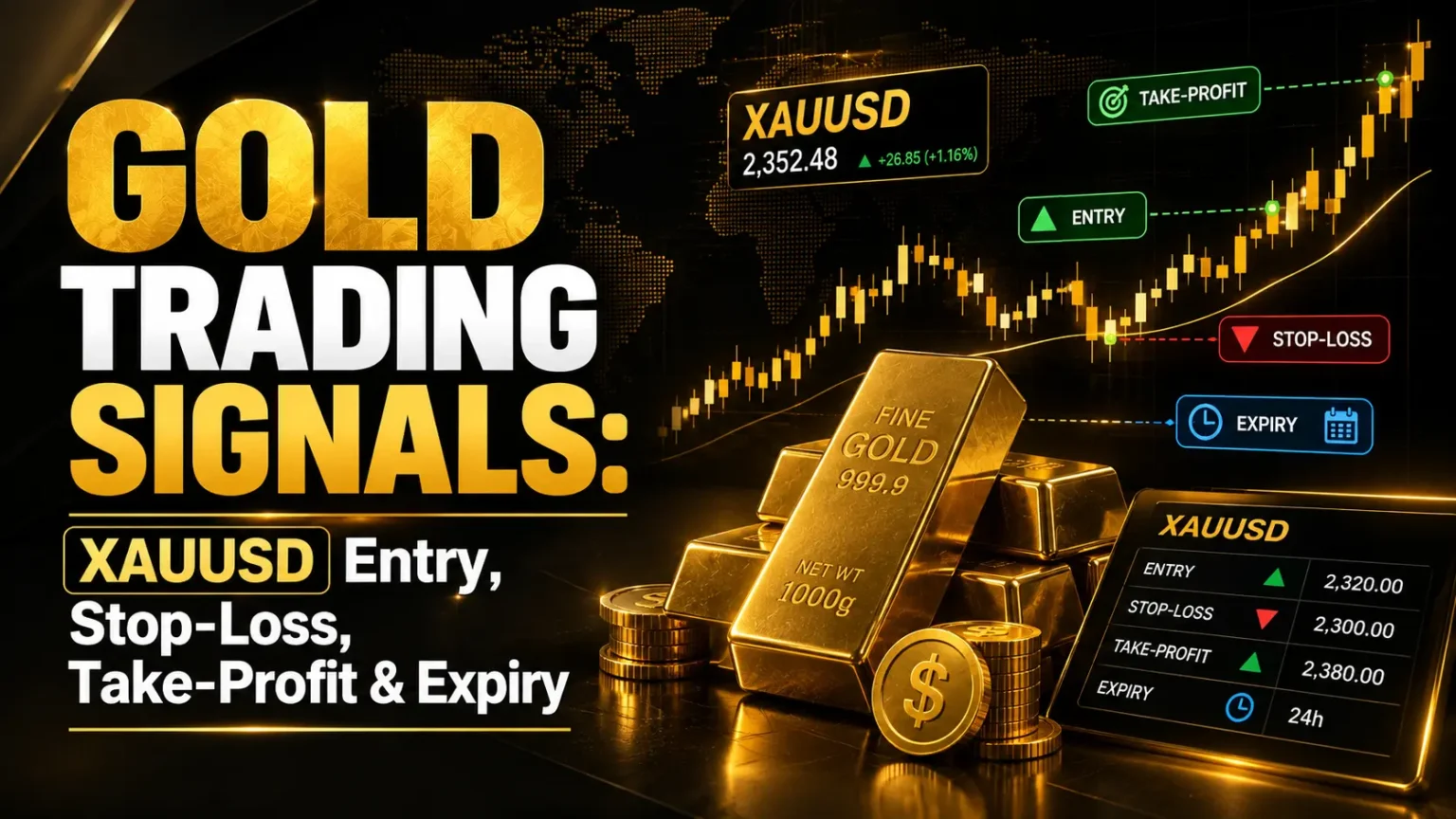
Gold Trading Signals: XAUUSD Entry, Stop-Loss, Take-Profit & Expiry
- Home
- Single Post
Get Free signals
Related Posts
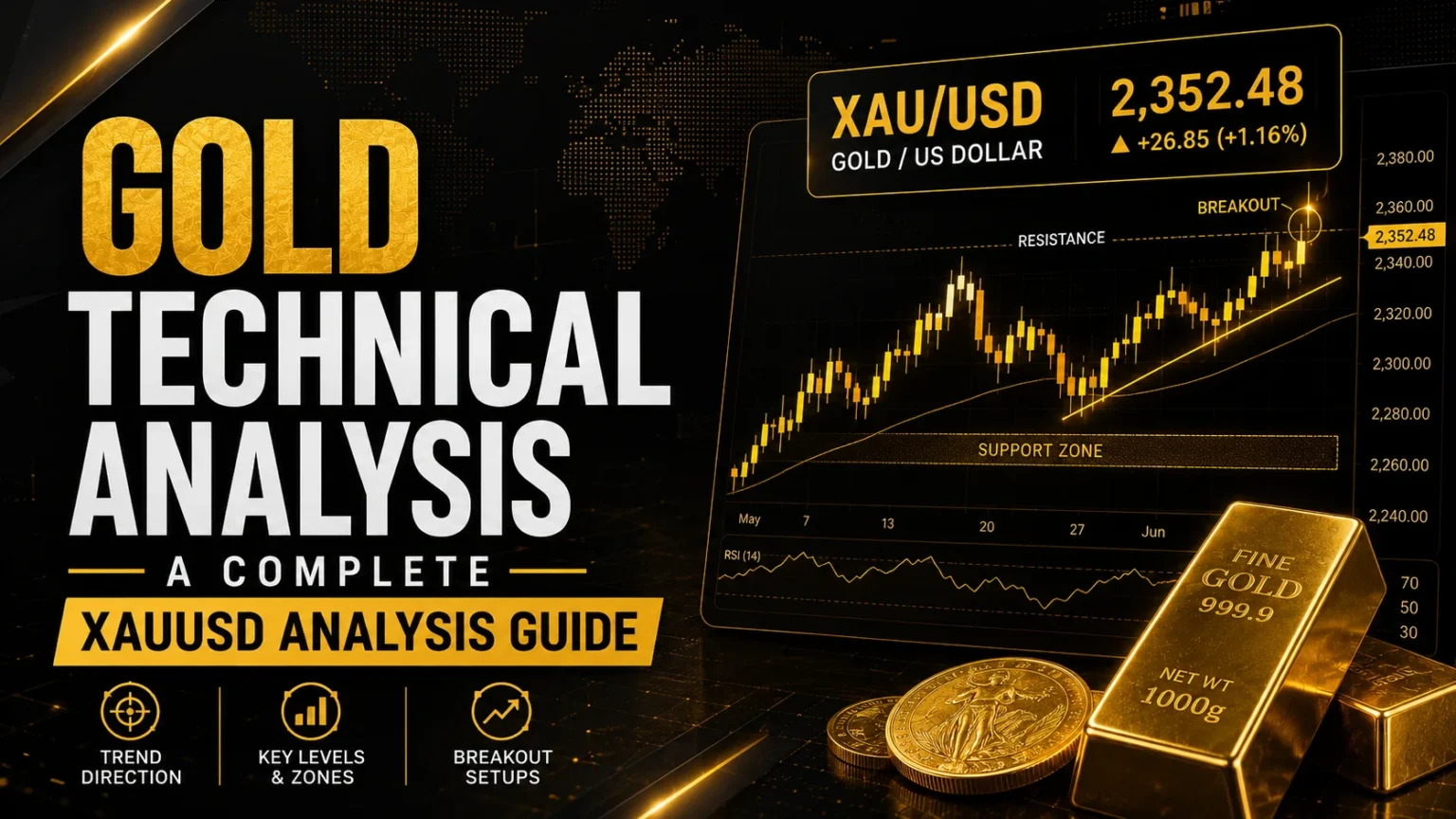
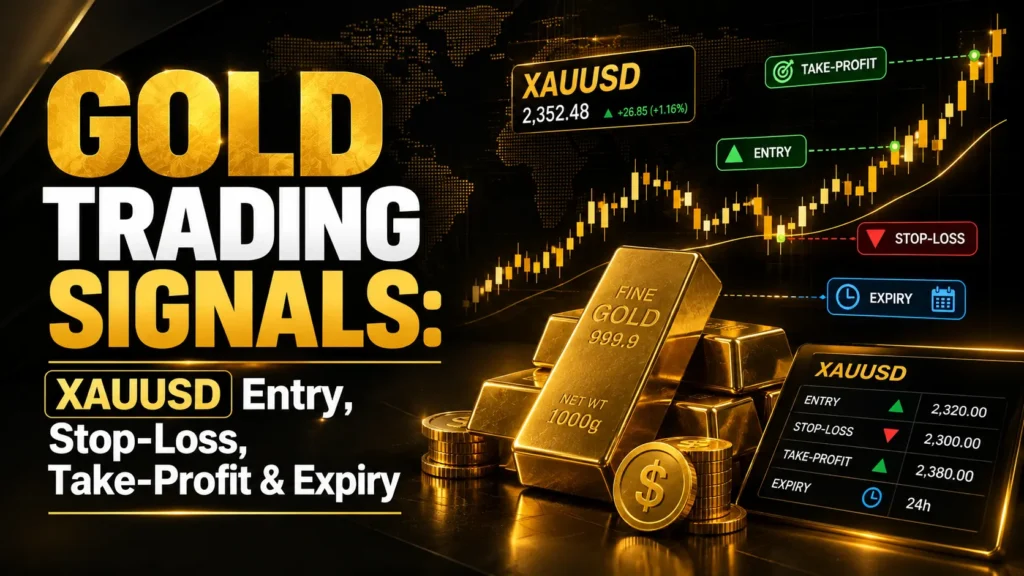
Gold trading signals are structured trade ideas that identify potential buying or selling opportunities in the gold market, usually XAUUSD. A complete gold trading signal typically includes a trade direction, entry price or zone, stop-loss, take-profit target, and expiry or cancellation condition.
These elements help traders understand when a setup becomes active, where the original trade idea becomes invalid, and where potential exits may be planned. However, gold trading signals do not guarantee profits. XAUUSD can move rapidly in response to economic data, interest-rate expectations, US dollar movements, central-bank decisions, and changes in market sentiment.
For beginners and intermediate traders, understanding how each part of a gold trading signal works is more important than simply following a buy or sell alert.
What Are Gold Trading Signals?
Gold trading signals are alerts or structured trade ideas for gold, usually XAUUSD, that identify a potential buy or sell setup.
A complete gold signal generally includes:
- Instrument: The market being traded
- Direction: Buy or sell
- Entry: Exact price, entry zone, or confirmation condition
- Stop-loss: Level used to control potential loss or invalidate the setup
- Take-profit: Planned profit target or targets
- Expiry: Time or condition after which the setup is no longer valid
- Analysis: The technical or fundamental reasoning behind the setup
A signal provides a framework for evaluating a potential trade. It does not guarantee a profitable outcome or replace independent analysis and risk management.
What Are Gold Trading Signals?
Gold trading signals are alerts that present a possible trading setup for gold. They may be created using technical analysis, fundamental research, price action, market sentiment, or a combination of these methods.
Most online gold signals focus on spot gold against the US dollar, commonly represented by XAUUSD. Traders unfamiliar with the instrument can first learn what spot gold is and how XAUUSD differs from physical gold ownership.
A standard gold trading signal may contain:
- The instrument being analyzed
- A buy or sell direction
- An entry price or entry zone
- A stop-loss level
- One or more take-profit targets
- A validity period
- A cancellation condition
- A short explanation of the analysis
This structure allows traders to evaluate both the potential opportunity and the associated risk.
Signal providers commonly study support and resistance, price patterns, momentum indicators, economic announcements, market structure, and market sentiment. The process is explained further in this guide to how gold signal providers generate buy and sell calls.
What Is an XAUUSD Trading Signal?
XAUUSD is the commonly used market symbol for gold priced against the US dollar.
An XAUUSD trading signal is therefore a trade setup focused specifically on movements in the gold-US dollar market.
Depending on the provider, an XAUUSD signal may use:
- Technical indicators
- Price action
- Support and resistance
- Market structure
- Economic data
- Interest-rate expectations
- US dollar movements
- Market sentiment
Understanding these factors can help traders evaluate why a particular gold signal has been generated rather than simply following its direction.
What Should a Complete Gold Trading Signal Include?
A useful gold trading signal should contain enough information to evaluate the setup and its potential risk.
| Signal Component | What It Means |
| Instrument | Identifies the market, usually XAUUSD |
| Direction | Shows whether the setup is a buy or sell |
| Entry | Defines the price, zone, or condition for entering |
| Stop-Loss | Defines the planned risk or invalidation level |
| Take-Profit | Identifies one or more potential exit targets |
| Expiry | Shows when the signal should no longer be considered active |
| Analysis | Explains the reasoning behind the setup |
Instrument
The signal should clearly identify the market being traded. For gold signals, this is normally XAUUSD.
Direction
The signal should state whether the proposed setup is a buy or sell.
Entry
The entry explains where the trade may be opened. This could be an exact level, an entry zone, or a condition that must occur before the trade becomes active.
Stop-Loss
The stop-loss identifies a predefined level where the trade’s original setup may be considered invalid or where the planned risk is reached.
Take-Profit
A take-profit identifies a planned exit area if gold moves in the expected direction. A signal may include one target or several target zones.
Expiry
The expiry tells traders when the alert should no longer be considered active.
Supporting Analysis
A well-structured signal may include a short explanation based on market structure, trend, momentum, fundamental conditions, or sentiment.
An alert that only says “buy gold” or “sell gold” does not provide enough information to evaluate the setup’s risk and trade conditions.
What Is an Entry Price in a Gold Trading Signal?
The entry price is the level or area where a gold trading setup is intended to become active.
Some signals use an exact entry level. Others provide an entry zone to allow for normal price movement and differences between broker quotes.
An entry may be based on:
- A reaction from support or resistance
- A breakout from consolidation
- A confirmed trend continuation
- A candlestick rejection
- A market-structure shift
- A pullback into a technical zone
Traders can study gold technical analysis to understand how analysts identify potential entry areas.
Market Entry vs Pending Entry
A market-entry signal suggests that the setup is active near the current market area.
A pending-entry signal activates only if gold reaches a specified price or confirms a particular condition.
Pending setups can help traders avoid entering before the expected confirmation occurs. However, an untriggered setup should be cancelled if the surrounding market structure changes.
What Happens When the Entry Is Missed?
A trader should not automatically assume that an alert remains valid after gold has moved beyond its planned entry.
Entering late may:
- Increase the distance to the stop-loss
- Reduce the remaining profit potential
- Change the original risk-to-reward relationship
- Increase exposure to a reversal
- Turn a structured setup into an emotional decision
Waiting for an updated signal may be preferable to chasing a missed move.
What Is a Stop-Loss in Gold Trading?
A stop-loss is an order intended to close a position when the market reaches a predefined level.
For a buy setup, the stop is generally placed below the entry area. For a sell setup, it is generally positioned above the entry.
An analyst may place a stop beyond:
- A recent swing high or swing low
- An established support or resistance zone
- A chart-pattern invalidation point
- A key market-structure level
- A volatility-based boundary
The stop-loss should reflect the point where the original trade reasoning is no longer valid or where the predefined risk limit is reached. It should not be selected randomly or placed unusually close to the entry simply to increase position size.
Does a Stop-Loss Eliminate Losses?
No. A stop-loss cannot eliminate trading losses or guarantee a specific execution price.
During sharp volatility, gaps, economic announcements, or limited liquidity, an order may be executed at a different level from the requested stop. This is known as slippage.
Spreads may also widen during volatile market conditions and affect the final trading result.
Position sizing therefore remains important even when a trade includes a stop-loss.
What Is Take-Profit in a Gold Signal?
A take-profit is an area where part or all of a trade may be closed if gold moves in the expected direction.
Take-profit levels may be based on:
- Previous support or resistance
- Swing highs or swing lows
- Chart-pattern objectives
- Liquidity zones
- A predefined risk-to-reward plan
- Changes in market structure
Some signals provide one final target. Others use multiple targets so traders can potentially close part of a position while leaving the remainder active.
Multiple targets can change how a trade is managed. Traders should understand the exit plan before entering a position.
How Does Risk-to-Reward Work?
Risk-to-reward compares the potential amount gained with the amount potentially risked.
For example, if a hypothetical setup risks $100 and has a planned potential profit of $200, the potential reward-to-risk relationship is 2:1.
A favourable risk-to-reward relationship does not guarantee that a trade will succeed. It simply provides a framework for comparing potential reward with planned risk.
What Does Gold Signal Expiry Mean?
Gold signal expiry refers to the time or market condition after which a particular trading setup should no longer be considered valid.
This is different from the expiry of a futures or options contract. Signal expiry refers specifically to the validity of the trade idea.
A gold trading signal may expire when:
- The entry condition is not met within the stated period
- The relevant trading session ends
- The market reaches the target without activating the entry
- Market structure changes before entry
- Important economic news changes the original conditions
- The provider cancels the setup
- Gold moves too far beyond the intended entry area
An intraday signal may remain valid for only one trading session. A swing setup may remain active longer if its original analytical conditions remain intact.
Understanding gold trading hours can help traders understand why an alert may be limited to a particular Asian, London, or New York trading session.
Is Gold Signal Expiry the Same as Contract Expiry?
No.
Gold signal expiry refers to the period during which a particular trading idea remains valid.
Contract expiry refers to the expiration of a financial derivative such as a futures or options contract.
These are separate concepts.
Why Is Entering an Expired Signal Risky?
An expired signal was based on a specific combination of price action, momentum, liquidity, and market conditions.
Following the same signal later could result in:
- An unsuitable entry
- A wider effective stop
- Less remaining profit potential
- A weaker risk-to-reward relationship
- Greater exposure to a reversal
A well-structured signal should ideally include a time-based expiry, session deadline, cancellation condition, or technical invalidation rule.
Gold Trading Signal vs Gold Trading Strategy
A gold trading signal and a gold trading strategy are related but different.
| Gold Trading Signal | Gold Trading Strategy |
| Specific trade idea | Broader trading methodology |
| Usually identifies a potential entry | Defines how trade opportunities are identified |
| May include entry, SL and TP | Includes entry, exit and risk-management rules |
| Often based on current conditions | Can be applied across multiple market conditions |
| Usually represents one setup | Can generate multiple setups |
In simple terms, a signal is an individual trade idea, while a strategy is the broader set of rules used to identify and manage trades.
Traders can explore gold trading strategies to learn more about different approaches.
Practical XAUUSD Signal Example Without Price Data
The following example is hypothetical and is provided only to explain how a structured signal works. It is not a current market alert or trading recommendation.
Hypothetical XAUUSD Setup
- Instrument: XAUUSD
- Direction: Buy
- Entry condition: Enter only after gold reacts positively from an identified support zone and confirms bullish momentum
- Stop-loss: Below the support zone and the setup’s invalidation point
- Take-profit one: Nearest confirmed resistance area
- Take-profit two: Next major resistance or liquidity zone
- Expiry: End of the stated trading session
- Cancellation: Cancel if support breaks before the entry condition is confirmed
This example demonstrates how a complete signal can define the conditions for activation, risk control, potential targets, and expiry.
The setup becomes active only when the entry condition is confirmed. If support breaks first, the trade is cancelled. If no entry occurs before the session ends, the signal expires.
This structure prevents traders from treating an old alert as permanently valid.
For broader context, the guide to the four golden signals for XAUUSD trading explains how trend, momentum, fundamentals, and sentiment can contribute to gold-market analysis.
Risk Management When Using Gold Trading Signals
Risk management should be considered before entering a trade, not after the position has been opened.
Practical considerations include:
- Define the maximum acceptable loss before entry
- Calculate position size based on the stop-loss distance
- Confirm that the signal remains valid
- Check the economic calendar
- Review the current spread and trading conditions
- Avoid increasing risk after a losing trade
- Do not widen a stop-loss simply to keep a losing position open
- Avoid following several highly correlated setups
- Record entries, exits, and execution differences
Gold can experience significant volatility around inflation reports, employment data, central-bank decisions, and other major economic events.
A technically structured setup can still experience rapid price movement when market conditions change.
Common Mistakes When Following Gold Signals
1. Entering Outside the Recommended Zone
Entering after gold has already moved significantly beyond the planned entry area can change the original risk profile.
2. Ignoring Signal Expiry
A previously valid setup may become unsuitable when the trading session, momentum, market structure, or fundamental environment changes.
3. Using Excessive Leverage
Leverage can magnify both gains and losses. A stop-loss does not make an oversized position safe.
4. Widening the Stop-Loss
Moving the stop farther away increases the planned potential loss and changes the original risk calculation.
5. Focusing Only on Win Rate
A signal provider or trading approach should not be evaluated solely by win rate. Other considerations can include risk-to-reward, drawdown, transparency, execution, and consistency.
6. Following Alerts Without Understanding Them
Signals should support informed decision-making rather than replace analysis.
Understanding why traders use gold signals can help traders establish more realistic expectations.
How to Evaluate a Gold Trading Signal Provider
Before using a gold signal provider, traders can consider several factors.
Methodology
Does the provider explain how signals are generated?
Transparency
Are both winning and losing trades presented rather than only successful examples?
Signal Structure
Does each alert clearly provide entry conditions, stop-loss, take-profit targets, and expiry rules?
Risk Information
Does the provider explain position sizing, leverage, drawdown, and potential losses?
Performance Claims
Are historical or hypothetical performance claims clearly identified and supported?
Execution
Can the provider’s signals realistically be executed under the stated market conditions?
Fees
Are subscription costs or other charges clearly disclosed?
The goal is to understand how a provider operates rather than relying solely on individual buy or sell alerts.
For additional comparison information, traders can review the Gold Trading Signals and XAUUSD Provider Guide and learn about free and paid gold signals.
How Elite Gold Signal Supports XAUUSD Traders
Elite Gold Signal provides XAUUSD trading signals, gold-market insights, and educational resources for traders looking for a structured approach to market analysis.
A properly communicated alert should identify the entry conditions, stop-loss, take-profit targets, and expiry rules. Traders can then evaluate whether the setup fits their broker conditions, account size, trading timeframe, and risk tolerance.
The purpose of a structured signal is to provide the information needed to understand a potential setup rather than presenting a simple unexplained buy or sell instruction.
Gold Trading Signal Checklist
Before using a gold trading signal, ask:
- Is the instrument clearly identified?
- Is it a buy or sell setup?
- Is the entry condition still valid?
- Is the stop-loss clearly defined?
- Are the take-profit targets explained?
- What is the planned risk-to-reward relationship?
- Does the position size match the intended risk limit?
- When does the signal expire?
- Has the setup been changed or cancelled?
- Is major economic news approaching?
- Do I understand the reasoning behind the setup?
Gold trading signals are most useful when entry, stop-loss, take-profit, and expiry are understood as parts of one complete trading plan.
Risk Disclaimer
This article is provided for educational and informational purposes only. It does not constitute personalized financial, investment, or trading advice.
The XAUUSD example is hypothetical and is not a live trading signal. Gold, forex, CFDs, and other leveraged products involve substantial risk. Losses can occur, and stop-loss orders may not execute at the requested level.
Conduct independent research and consider your financial circumstances, trading experience, and risk tolerance before trading.
Frequently Asked Questions
What are gold trading signals?
Gold trading signals are structured trade ideas for gold, usually XAUUSD. They generally include a buy or sell direction, entry condition, stop-loss, take-profit, and validity period.
How do gold trading signals work?
A gold trading signal identifies a potential market setup based on factors such as technical analysis, price action, fundamentals, momentum, or sentiment. The signal then provides conditions for entry, risk management, potential exits, and expiry.
What is an XAUUSD trading signal?
An XAUUSD trading signal is a trade setup focused on gold priced against the US dollar. It may identify a potential buy or sell opportunity based on current market conditions.
What should a gold trading signal include?
A complete signal should ideally identify the instrument, direction, entry, stop-loss, take-profit, expiry, cancellation condition, and supporting analysis.
How long does a gold trading signal remain valid?
The validity depends on the strategy and timeframe. An intraday signal may expire within one market session, while a swing setup may remain valid longer if its original conditions remain intact.
Can beginners use gold trading signals?
Beginners can use signals as a way to understand structured trade planning, but they should first learn about position sizing, leverage, order types, and risk management. Demo practice may be appropriate before risking real capital.